
Graph Park
About Graph Park
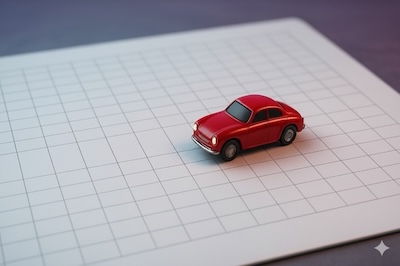
Graph Park is an interactive coordinate mathematics game that combines graph-reading practice with a playful top-down driving challenge. Instead of answering questions through a traditional worksheet, players read a visual question board, identify the correct mathematical answer, and drive a small car into the parking bay displaying that answer. This makes every question feel like a short mission. The game is designed to help learners connect numbers, coordinates, lines, and equations with their visual positions on a graph while also keeping them actively involved through movement, sound, scoring, and immediate feedback.
How the Game Works
Each round contains twenty questions. A graph and a short instruction appear beside the parking area, while four possible answers are placed inside colored parking bays. Players inspect the graph, calculate or identify the answer, and then control the car using a keyboard or the on-screen mobile controls. Once the car is inside a chosen bay, the player presses the Park button to submit the answer. A correct choice awards points, increases the current streak, and moves the player to the next question. An incorrect choice reduces the score slightly but allows the player to examine the graph and try again.
Beginner and Easy Modes
Beginner mode introduces the coordinate plane with positive values from one through ten. Its questions focus only on identifying individual x-values and y-values, making it suitable for learners who are meeting coordinate graphs for the first time. The numbered interval is one, so every labeled step is easy to follow. Easy mode expands the graph to include positive and negative coordinates. Its first ten questions ask for individual x-values or y-values, while its final ten questions ask for complete ordered pairs. Easy mode labels the graph at intervals of two while each smaller grid square continues to represent one unit.
Medium and Hard Modes
Medium mode moves beyond basic coordinate reading and introduces points on lines, y-intercepts, slopes, and reflections across the x-axis. These questions require players to connect algebraic information with the line or point shown on the graph. Hard mode introduces systems of equations, quadratic evaluation, distances between two points, and x-intercepts. The advanced questions are still presented visually, but they require additional calculation and careful interpretation. Every mode provides four unique answer choices with exactly one correct option, and the question-generation logic keeps important points and markers inside the visible graph.
Controls and Accessibility
Desktop players can drive with the arrow keys or the W, A, S, and D keys. Mobile players receive clearly labeled Left, Right, Gas, and Brake controls sized to fit narrow screens. The car can turn while stationary, steer at low speed, and respond correctly while reversing. A reset control is available if the car becomes difficult to position. Responsive layouts reorganize the graph, parking area, menus, and controls for phones, tablets, landscape screens, and shorter browser windows. The home screen can scroll when necessary so difficulty choices are not cropped.
Feedback, Sound, and Motivation
Graph Park uses visual effects, local sound effects, point rewards, streak tracking, and end-of-round rankings to make progress easy to understand. Correct parking triggers a celebratory response, while an incorrect bay receives clear but friendly feedback. Sound effects load from local audio files first and automatically fall back to generated browser audio if a file cannot be played. Players can also mute all sounds. At the end of a round, the game summarizes the score, correct answers, best streak, and incorrect parking attempts, encouraging learners to replay a mode and improve both their mathematical accuracy and driving control.
Learning Purpose
The main purpose of Graph Park is to turn abstract graph concepts into visible, repeatable actions. Players do not simply memorize coordinate rules; they repeatedly locate axes, compare signs, read ordered pairs, inspect slopes, and connect equations to graphical features. Because questions are randomized, repeated rounds provide new examples rather than a fixed answer sequence. The combination of mathematics and navigation supports focused practice while maintaining a light, game-like atmosphere suitable for independent learning, classroom stations, demonstrations, or additional practice at home.