
Poikilia: Additive and Subtractive Colors




Poikilia
Poikilia is a puzzle and educational game created by the Singapore-MIT GAMBIT Game Lab. Instead of teaching color theory through diagrams or long explanations, the game turns the subject into a maze-based adventure. Players move through mysterious rooms where light and color become part of the puzzle itself. The main idea is simple to understand: observe what happens to different colors, experiment with the environment, and work out how to reach the next area.
What makes Poikilia interesting is that the educational part does not feel completely separated from the gameplay. The puzzles themselves are built around additive and subtractive color theory, so learning happens naturally while you are trying to solve each challenge. You are not simply answering questions about colors. You actually see how different combinations of light and color behave inside the maze.
Explore a Maze Built Around Light and Color
The game places the player inside a dark, maze-like environment filled with pathways, obstacles, and color-based mechanisms. Progress depends on paying attention to the colors you encounter and understanding how they affect the world around you. Some situations may initially seem confusing, especially when the behavior of colored light does not match what you expect from mixing paint or other physical materials.
That confusion is an important part of Poikilia. The game encourages experimentation rather than immediately giving away the answer. When something does not work, you can reconsider what happened, try a different approach, and gradually understand the rule behind the puzzle. This gives the game the feeling of a small scientific experiment wrapped inside a maze adventure.
Learning Additive and Subtractive Color Theory
The central educational topic in Poikilia is the difference between additive and subtractive color. These two systems can be surprisingly difficult to understand because colors behave differently depending on whether you are dealing with light or pigments. Poikilia uses its puzzles to make these ideas more visual and interactive.
Instead of memorizing definitions, players can observe the results of combining or manipulating colors during gameplay. Seeing these changes happen directly can make the concepts easier to remember. It also encourages players to think about why a particular result occurred rather than simply accepting a fact from a textbook.
A Story Version and a Non-Narrative Version
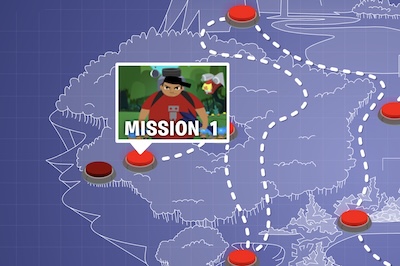
Poikilia was designed with both a narrative and a non-narrative form. The story-based version presents its adventure with cutscenes and in-game artwork, giving players more context while they travel through the maze. This adds a sense of purpose and atmosphere to the experience, making the puzzles feel like part of a larger journey.
The non-narrative version removes much of that storytelling while keeping the core gameplay intact. Both approaches use the same fundamental color puzzles, but they present the experience differently. This makes Poikilia particularly interesting as an educational game because it was also used to explore how storytelling can affect engagement and learning.
More Than a Typical Educational Game
Poikilia does not feel like a traditional classroom exercise with a game placed on top of it. Its maze structure, visual atmosphere, and experimentation-based puzzles give players a reason to keep exploring. Learning becomes part of solving the environment rather than a separate test that interrupts the action.
The game is especially suitable for players who enjoy puzzles that require observation and logical thinking. You may need to stop, look carefully at the available colors, remember what happened during an earlier experiment, and then apply that knowledge somewhere else. That process gives the puzzles a satisfying sense of discovery.
Why Poikilia Is Still Interesting
Even though Poikilia comes from an earlier generation of browser-based educational games, its central idea remains clever. Color theory is a subject that becomes much easier to understand when it can be seen and tested, and Poikilia gives players an interactive way to do exactly that.
For anyone interested in puzzle games, educational games, or unusual uses of light and color, Poikilia offers something different. It combines maze exploration with genuine learning concepts and allows the player to understand those concepts through experience. Rather than simply telling you how colors work, Poikilia gives you a world where figuring that out is the key to moving forward.