
Fishy Numbers


Fishy Numbers
Fishy Numbers is a colorful educational maths game that turns basic arithmetic into a simple underwater challenge. Instead of working through a page of number problems, players solve calculations by looking at numbered fish swimming around the game board. The activity combines addition, subtraction, multiplication, and division with a turn-based scoring system, making it a useful way for children to practise mental maths while still feeling as though they are playing a game. The friendly sea theme, hand-drawn fish, shells, seaweed, and bright numbers give the activity a relaxed classroom-game feel that is suitable for younger learners.
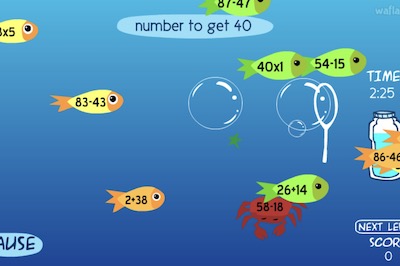
The main game screen shows a collection of fish carrying different numbers. These include smaller values such as 1, 2, 3, and 4 as well as larger numbers such as 7, 8, 9, 10, and 12. At the side of the screen, two numbers are displayed for the current turn. Players use these numbers together with one of the available mathematical operations. Addition, subtraction, multiplication, and division symbols are provided at the bottom of the play area, encouraging children to think about the different answers that can be produced from the numbers they have been given.
For example, if the displayed numbers are 3 and 4, a player can immediately start thinking about familiar number relationships. Adding them gives 7, multiplying them gives 12, and subtracting the smaller number from the larger one gives 1. The player then looks around the underwater board for a fish carrying a suitable answer. This turns each turn into a short mental maths puzzle because the child has to calculate first and then visually locate the corresponding number among the fish.
Fishy Numbers is especially useful because it encourages children to see that the same pair of numbers can be used in several different ways. A traditional maths question often gives one operation and asks for one answer, but this game places several operation symbols in front of the player. That encourages a little more experimentation. Children can ask themselves what happens when the numbers are added, subtracted, multiplied, or divided instead of automatically performing a single calculation.
The game also includes a multiplayer-style turn system. The current player is clearly shown on the side of the screen, and separate scores are displayed for Player 1 and Player 2. Successfully claimed fish are marked with colored outlines, making it easy to see which numbers have already been taken by each player. This adds a friendly competitive element because each player is trying to build a better score while also paying attention to which fish are still available on the board.
There is also a “Skip a go” option, which can be useful when a player cannot find an appropriate move or would rather pass the turn. An Instructions button is available as well, so new players can check how the activity works before continuing. These simple controls keep the game easy to follow without covering the screen with complicated menus or unnecessary options.
From an educational point of view, Fishy Numbers can support several important maths skills at the same time. Children practise quick addition and subtraction, recall multiplication facts, think about division, recognize numbers visually, and compare possible results. Because the numbers are presented as part of a game rather than as a long list of equations, learners may be more willing to try different calculations and correct themselves when an answer does not fit.
The game can work well for two children playing together, but it can also be useful in a classroom with a teacher guiding the activity. A teacher could ask a child to explain why a particular fish is correct before selecting it. Instead of simply saying “the answer is 12,” the learner could explain that 3 multiplied by 4 equals 12. This small extra step turns the activity into useful speaking and reasoning practice as well as a calculation game.
The underwater design gives Fishy Numbers much of its personality. The numbered fish are large and easy to distinguish, while the seaweed and shells around the edges make the board feel playful without distracting from the maths. The numbers themselves remain the most important part of the screen, which is exactly what an educational game like this needs.
Overall, Fishy Numbers is an enjoyable way to practise basic arithmetic through a combination of calculation, number recognition, strategy, and friendly competition. Its simple rules make it approachable for children, while the use of several mathematical operations gives players plenty to think about during each turn. For learners who find ordinary worksheets repetitive, Fishy Numbers provides a more interactive way to strengthen mental maths skills and become quicker and more confident when working with numbers.